
Tennessee Justice Center - Case Study
Location
Nashville, Tennessee
Status
Completed Fall 2023
Size
27,350 SF
Client
Tennessee Justice Center
Shop Team
James Kennon
Katherine Kennon
Cary Sweat
Project Collaborators
Civil Engineer: Collected Civil Engineering
Landscape Architect: Studio Topography
Structural Engineering: EMC Structural Engineers
Mechanical Engineering: Lee Company
Electrical Engineering: Thompson Electric
Plumbing and Fire Protection Engineering: Dewberry|Edmonds
General Contractor: PBG Builders
Professional Photography: Sterling Stevens
Awards
Urban Land Institute Excellence in Development Award, 2024
Middle Tennessee AIA Merit Award, 2024
Project Brief:
Reimagined as a welcoming hub for advocacy and community empowerment, the renovated facility for the Tennessee Justice Center provides expanded space for legal services while honoring its historic site. Responding to zoning, floodplain, and structural constraints, the design sensitively inserts a third floor while preserving the building’s original footprint. Enhanced site infrastructure, energy upgrades, and shared nonprofit space support long-term growth.
Design for Equitable Communities:
Anchored in Nashville’s underserved Napier Park neighborhood, the Tennessee Justice Center’s new home advances equitable access to legal advocacy by embedding services within the community it serves. Positioned at the intersection of three public streets and within sight of downtown, the building enhances visibility and access for clients historically marginalized by distance or infrastructure. The renovation preserves the existing footprint while improving stormwater management and pedestrian infrastructure, including new sidewalks that reinforce safe, accessible public realm connections.
TJC’s work is also shaped by broader statewide inequities in income, healthcare access, and public support systems. Mapping median household income alongside access to maternity care illustrates the uneven conditions affecting many of the families TJC serves across Tennessee. Proximity to underserved populations was therefore a deliberate siting choice, allowing TJC to meet people where they are, physically and socially. Programmatic flexibility within the expanded space enables shared use with other nonprofit organizations, subsidizing costs and fostering collaboration. The architectural expression, rooted in practical upgrades and visible reinvestment, signals to the neighborhood that it is both seen and valued.
Design for Resources:
The Tennessee Justice Center project began with the disciplined reuse of an existing urban building rather than replacement. Originally constructed in 1956 and later marked by years of neglect, the structure retained substantial concrete and masonry components that could be repaired, reinforced, and extended into a new service life. Because site limitations restricted any increase to the building footprint, the design added vertically, inserting a new third floor above the previous roof while preserving the building’s existing site presence. This approach reduced new land disturbance and avoided the unnecessary disposal of carbon-intensive materials already invested in the building.
Resource conservation continued through targeted upgrades to the existing envelope and structure. The concrete frame, precast floor and roof structure, and perimeter masonry walls required analysis, reinforcement, remediation, or replacement where needed to meet the project’s renewed programmatic demands. New code-compliant perimeter insulation and windows improved energy performance while allowing the original building to remain the basis of the design. Rather than treating the existing structure as a limitation, the project used it as the primary resource, transforming a derelict commercial building into a durable civic asset for long-term nonprofit use
Design for Economy:
The Tennessee Justice Center project advances economic resilience by converting a long-term operational burden into a stable institutional asset. After years of displacement caused by rising rents and building redevelopment, ownership allowed TJC to control facility costs, reduce service disruption, and direct more resources toward programmatic work. The renovation also created capacity beyond the organization’s immediate needs, allowing surplus office area to be leased to another local nonprofit while shared amenity spaces support community meetings, events, and youth programming. In this way, the building functions not only as a workplace, but as a financial and civic platform for sustained nonprofit service.
The design response also reflects a disciplined use of limited resources. Rather than expanding the building footprint, the project added vertically, preserving the existing site limits while capturing additional usable area. The basement, constrained by floodplain conditions and unsuitable for quality workspace, was converted into secure parking, avoiding costly investment in a compromised occupied environment. Existing concrete and masonry construction were retained and upgraded where feasible, extending the service life of the building while reducing the need for unnecessary new construction. Together, these decisions demonstrate an economy rooted in long-term stewardship, adaptive reuse, and practical investment.
Design for Ecosystem:
The Tennessee Justice Center project approached ecosystem impact through the careful repair of an already-developed urban site. Previously fully paved and constrained by floodplain, zoning, and stormwater limitations, the site offered limited opportunity for expansion but significant opportunity for improvement. Rather than enlarging the building footprint, the design preserved the existing structure and added vertically, reducing pressure on the surrounding site while extending the life of the existing concrete and masonry construction. This strategy limited new land disturbance and avoided the unnecessary removal and replacement of carbon-intensive building materials.
Site improvements focused on managing water more responsibly within a constrained urban condition. The project reduced impervious surface area, introduced flood vents at the basement level, improved sidewalks, and incorporated a bioretention pond to address stormwater impacts. While the project is not primarily a landscape or habitat restoration effort, these interventions improve the relationship between the building, the public realm, and the site’s hydrological conditions. In this way, the design recognizes the ecological consequences of redevelopment and uses practical, site-specific measures to soften the impact of a previously hard-surfaced property.
Design for Integration:
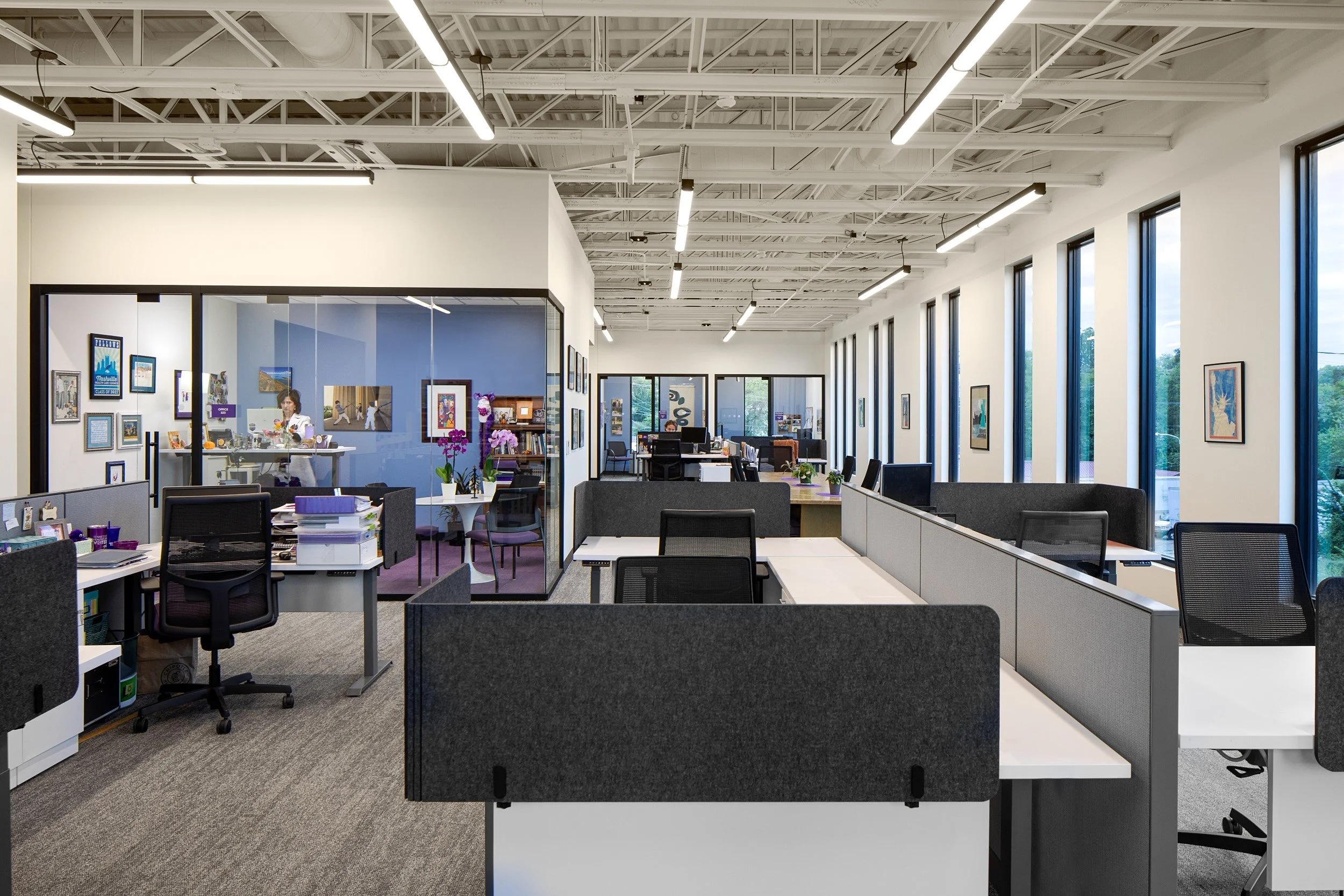
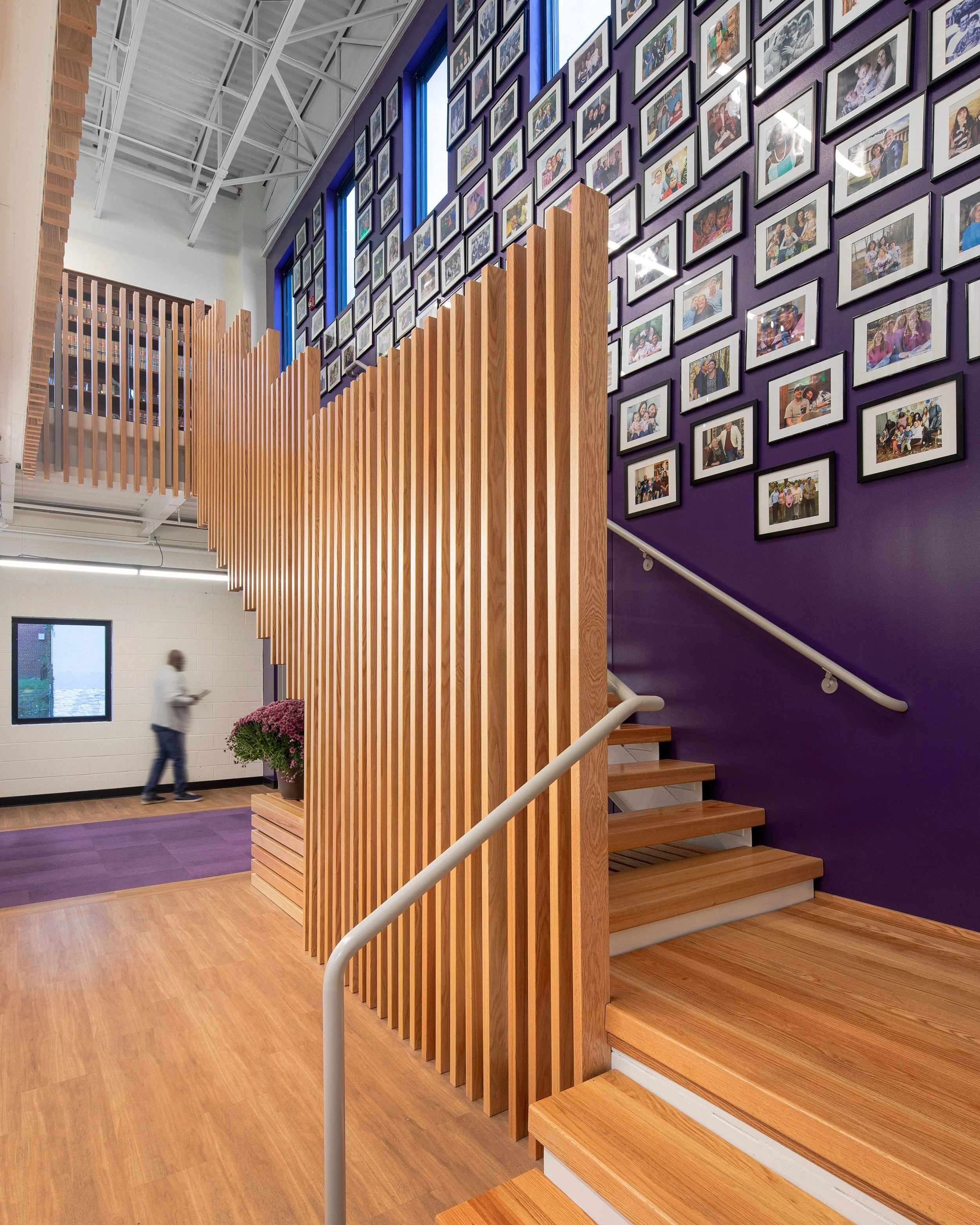
Inside, the building prioritizes dignity and functionality through thoughtful material selection, flexible planning, and spaces that support both focused work and informal connection. Private meeting rooms with translucent historic image films balance transparency and confidentiality, while natural light animates corridors and shared areas to foster a sense of openness. Each floor includes centralized staff amenities, break areas and informal meeting spots, that encourage collaboration across teams. Salvaged architectural elements, including original pews and vintage lighting, were repurposed to ground the interior in local memory. Together, these details create a layered, human-centered environment that reflects TJC’s values and enhances daily experience for staff, partners, and clients alike.
Design for Well-being:
The Tennessee Justice Center project supports well-being by creating a workplace and service environment grounded in dignity, daylight, and human connection. New windows bring natural light into offices, corridors, and shared areas, while interior glass walls extend that sense of openness deeper into the building. Private meeting rooms balance transparency with confidentiality, allowing clients and advocates to meet in spaces that feel protected without becoming isolated. These decisions are especially important within a legal advocacy setting, where comfort, trust, and privacy are essential to the daily experience of both staff and clients.
Staff well-being is supported through informal gathering areas, centralized break spaces, and a rooftop patio connected to the staff lounge. These amenities provide moments of relief within demanding work centered on public service and vulnerable populations. Salvaged architectural elements, mission-driven graphics, and local artwork further humanize the interior, tying the renovated building to memory, identity, and place. Together, the design transforms a once-neglected commercial structure into an environment that supports focused work, shared purpose, and a healthier daily rhythm for the people who use it.